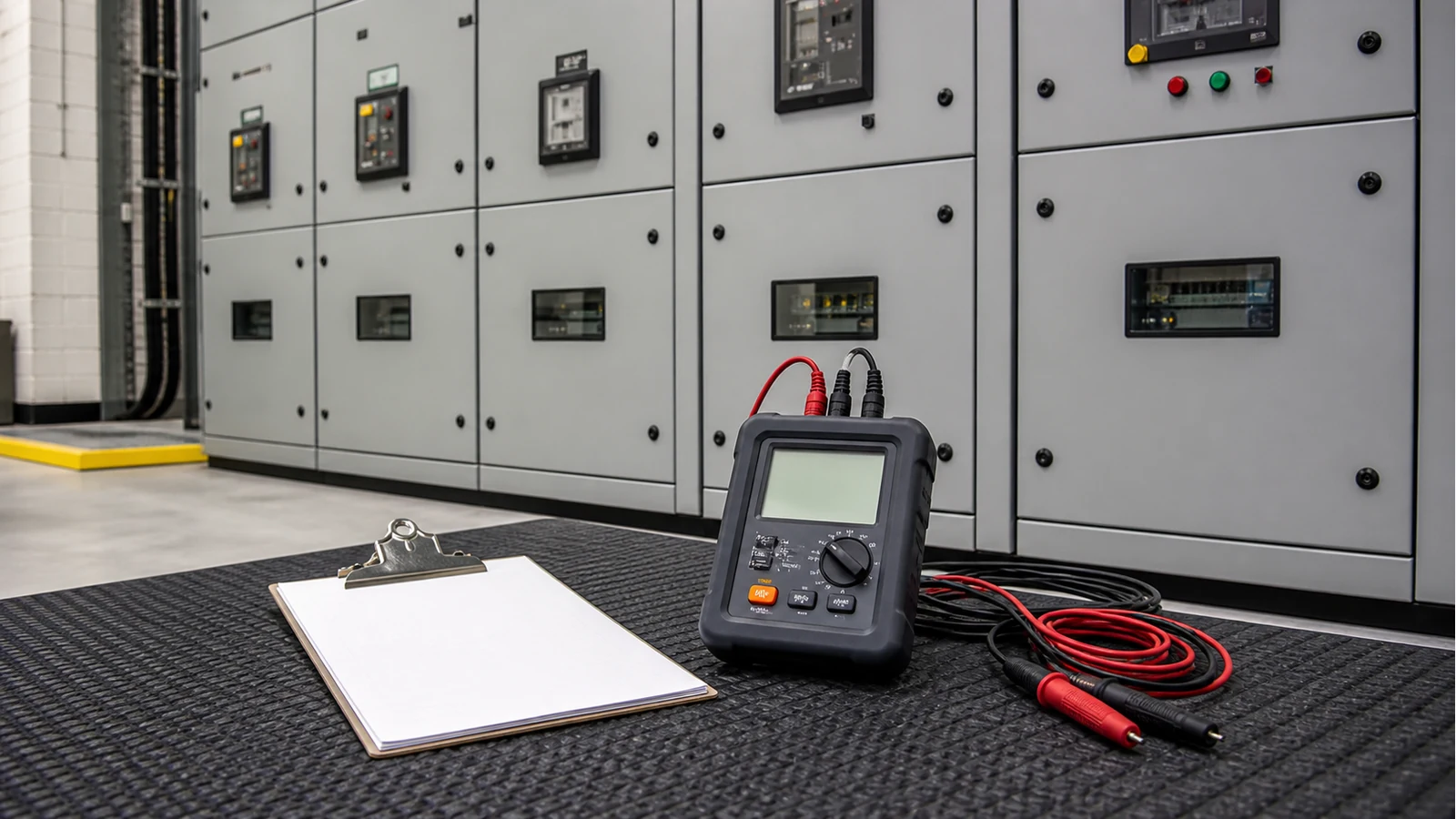
Switchgear Insulation Resistance Testing UK
Direct answer: insulation resistance and PI-style checks can support switchgear commissioning and maintenance baselines, but they are not a full condition assessment on their own. Use them as part of a controlled dead-test process, compare results with manufacturer or site criteria, and escalate when the asset needs partial discharge, thermal, oil, contact resistance or specialist high-voltage diagnostics.
The public HSE material is useful because it keeps the scope realistic. HSE HSG230 lists insulation resistance measurements and polarisation index calculations among diagnostic tests that can be used around commissioning to establish baselines. The HSE HSG230 publication page identifies the guide as aimed at owners and operators of industrial and commercial switchgear.
Baseline Workflow
- Define the switchgear section, isolation boundary and manufacturer limits before testing.
- Confirm the test voltage and whether a 1000 V-class handheld instrument is within the intended scope.
- Use lock-off, prove-dead and discharge controls from the UK insulation resistance safety checklist.
- Record phase-to-phase and phase-to-earth results as required by the method statement.
- Capture conditions that affect comparison: humidity, temperature, contamination, recent cleaning and cable connection state.
- Store the first reliable result as a baseline, then compare later tests against that baseline rather than a guessed universal number.
When To Escalate
Escalate if the switchgear is high voltage, if the manufacturer specifies another diagnostic method, if contamination or tracking is visible, if results are unstable after drying or cleaning, or if the failure history points to contact, thermal or partial-discharge problems. A handheld megohmmeter cannot prove the absence of every switchgear defect.
Where Long Cables Complicate The Picture
Switchgear tests often include connected cable sections. Long cable capacitance can make readings slow to settle and can leave stored charge after a DC test. The commissioning guide for long cable runs covers that practical problem in more detail.
Sources
- HSE HSG230 Keeping electrical switchgear safe PDF
- HSE HSG230 publication page