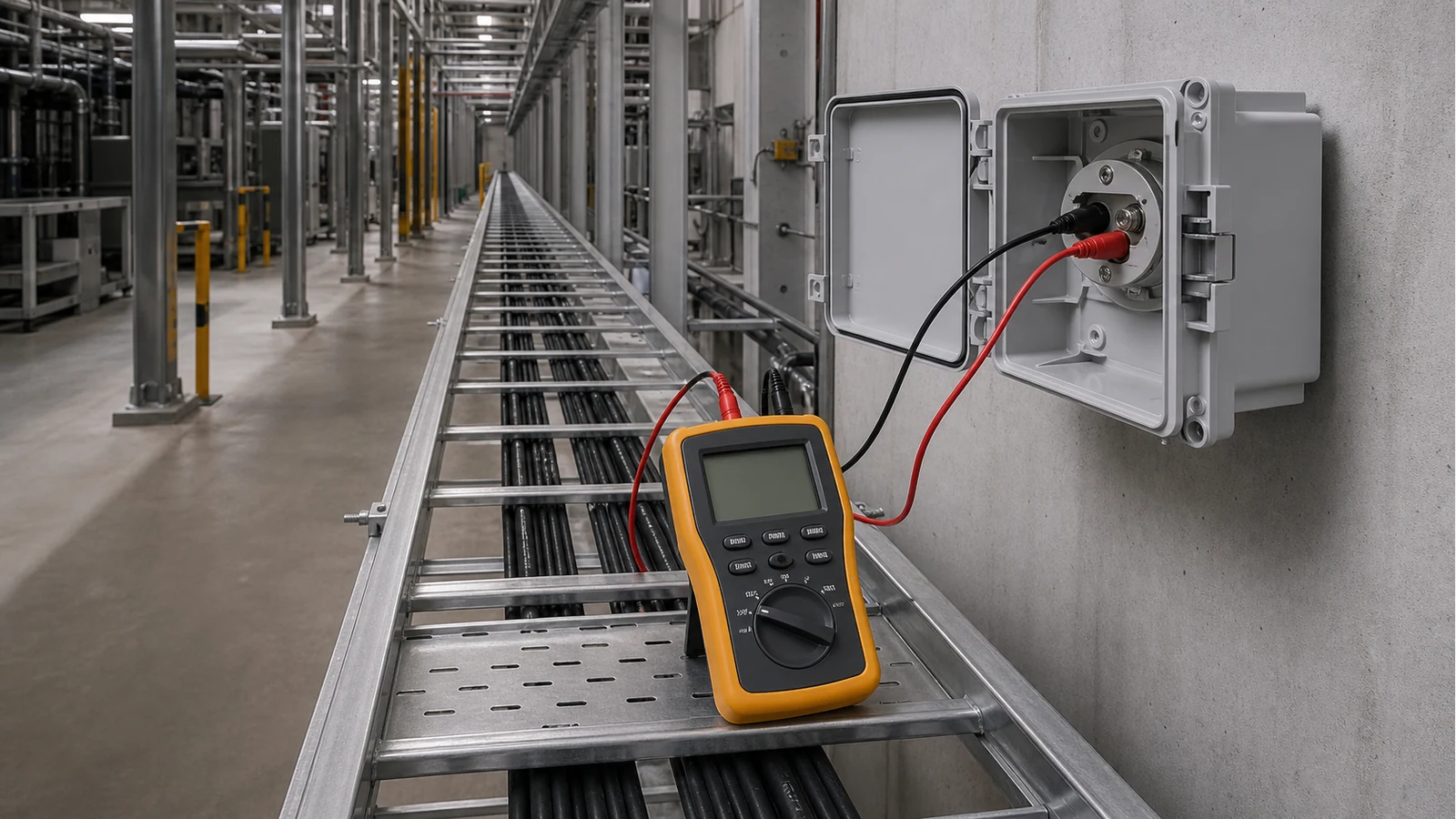
Commissioning Insulation Tester Long Cable Runs UK
Direct answer: long cable runs can show lower raw resistance than short circuits, take longer to charge, and retain energy after a high-voltage DC insulation test. For commissioning, isolate both ends, select the correct voltage, wait for a stable reading, record the result as a baseline and discharge safely before anyone handles conductors.
Cable-specific guidance explains why length changes measured resistance and why discharge matters after DC testing. The InsulationTesting.com cable insulation testing guide covers length, stable test duration and post-test discharge. UK installation teams still need voltage selection discipline, and the Elec-Mate BS 7671 insulation resistance guide summarises the familiar 250/500/1000 V framework used around verification work.
Commissioning Sequence
- Confirm cable identity, route, connected equipment and both-end isolation.
- Remove or protect connected electronics and surge devices according to the design and method statement.
- Select the DC test voltage for the circuit rather than defaulting to the highest range.
- Apply the test and wait for the reading to stabilise under the chosen method.
- Record length, conductor set, voltage, duration, reading and environmental notes.
- Discharge the cable through the tester or approved discharge method before disconnecting leads.
Why Headroom Helps
A tester that tops out early can make every good long run look the same. More resistance range gives a cleaner baseline for comparison, especially when multiple runs are being handed over. That does not mean every long wet cable will read near the top of the scale, and it does not create a universal pass value. Project specifications and current standards remain the controlling documents.
When Not To Use A 1000 V Handheld Tester
Do not force a portable 1000 V tester into work that calls for 5-10 kV diagnostic cable systems, sheath testing, VLF, tan delta or specialist HV procedures. If the cable terminates in switchgear, coordinate with the switchgear baseline method in the switchgear insulation resistance guide. If the uncertainty is simply voltage selection, start with the BS 7671 voltage checklist.
If your work is portable 1000 V commissioning and you want high-range headroom rather than a full specialist HV cable set, compare your method statement against the 1000 V digital megohmmeter insulation tester.
Sources
- InsulationTesting.com cable insulation testing guide
- Elec-Mate guide to BS 7671 insulation resistance testing