Electrical Insulation Meter Explained: A UK Buyer's Guide
Key Takeaways
TL;DR: An electrical insulation meter is a high-voltage tester used to check the insulation resistance of dead circuits, cables, motors and switchgear. In the UK, it is essential for BS 7671 testing, with 500V DC commonly used on standard 230V installations and 1000V DC used for higher-voltage or industrial applications. Based on our testing, the most useful models combine selectable test voltages, a wide GΩ range, and clear PI/DAR diagnostics for faster fault-finding.
- BS 7671 Compliance: An accurate electrical insulation meter is essential for verifying dead-circuit safety and insulation resistance during EIC and EICR inspections.
- Voltage Selection Matters: Testing requires the correct test voltage pairing—typically 500V for standard 230V UK domestic installations and up to 1000V for industrial switchgear and motors.
- Advanced Diagnostic Metrics: Beyond simple resistance readings, modern digital megohmmeters offer Polarisation Index (PI) and Dielectric Absorption Ratio (DAR) to detect moisture and insulation degradation before catastrophic failure.
- Measurement Range: For serious fault-finding across industrial plant maintenance, an instrument capable of reading up to 100GΩ helps avoid over-range blind spots.
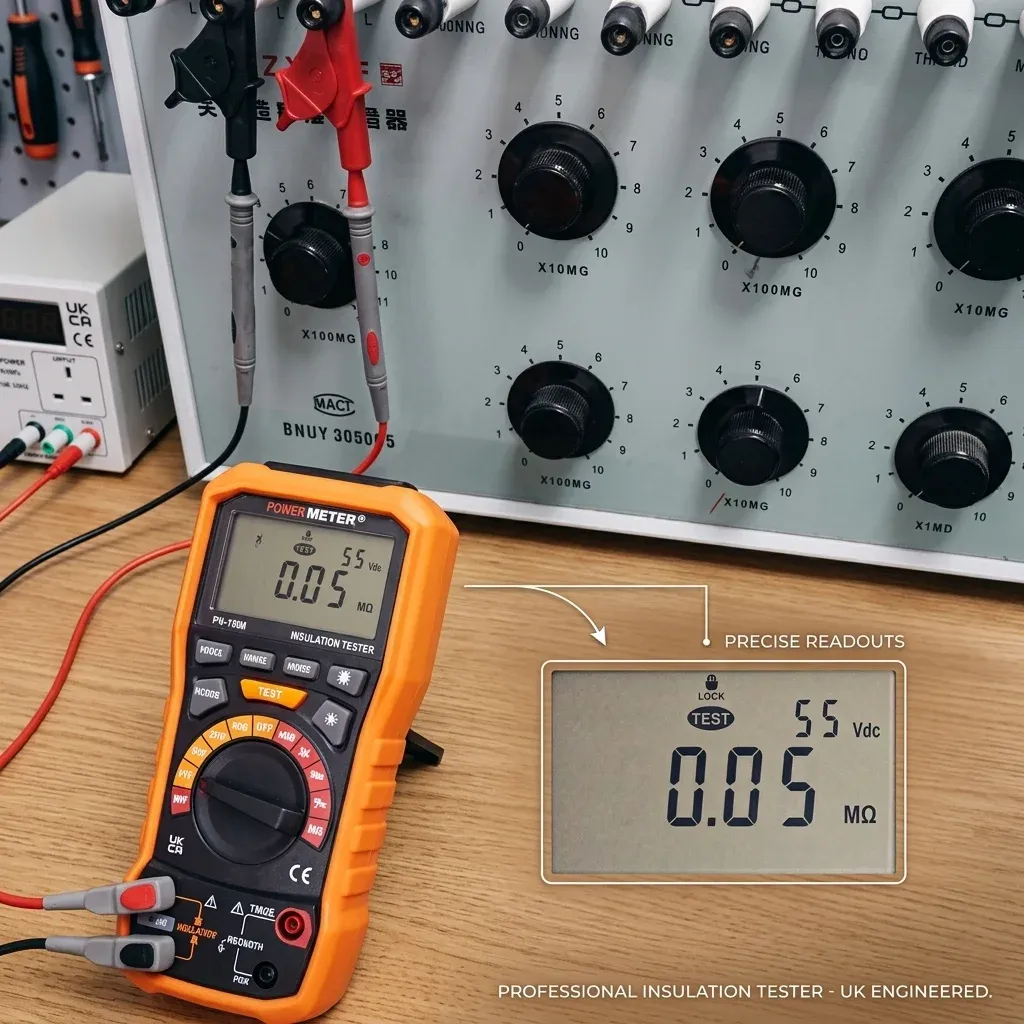
An electrical insulation meter, also known as an insulation resistance tester or megohmmeter, measures how effectively cables, circuits, motors and electrical equipment resist leakage current. Unlike a standard multimeter, it applies a high DC test voltage—typically 250V, 500V or 1000V—to a dead circuit so electricians and engineers can confirm whether insulation is safe, compliant and fit for service.
Whether you are signing off an Electrical Installation Condition Report (EICR) for a commercial property in Manchester or diagnosing a tripping motor drive in a Midlands manufacturing plant, a reliable electrical insulation meter is a core part of the diagnostic toolkit. Standard multimeters can measure continuity and low resistance; however, they do not have the high-voltage output needed to stress-test insulation in wiring, switchgear and industrial machinery.
According to UK guidance under BS 7671:2018+A2:2022, insulation resistance testing is a key part of initial verification and periodic inspection. Therefore, using precise and repeatable test equipment is vital not only for compliance but also for personal safety, fault prevention and plant uptime.
What is an electrical insulation meter?
An electrical insulation meter—commonly referred to in the UK trade as a megohmmeter or insulation resistance tester—is a specialised instrument designed to measure the resistance of insulating materials. Unlike standard multimeters, which operate at low voltages, an insulation meter injects a controlled direct current (DC) test voltage ranging from 250V up to 1000V or more into a dead circuit.
As a result, the instrument forces a very small leakage current through the insulation material. Using Ohm's Law, the meter calculates and displays the insulation resistance in megohms (MΩ) or gigohms (GΩ). Healthy insulation usually produces a very high resistance reading, whereas deteriorating insulation caused by heat, moisture or mechanical damage allows more leakage current and therefore shows a lower reading.
How does an electrical insulation meter work?
An electrical insulation meter works by applying a known DC voltage across conductors and then measuring the tiny current that leaks through the insulation. It then converts that relationship into an insulation resistance value. In simple terms, higher resistance means better insulation performance.
For example, if cable insulation is dry and intact, the reading may be many megohms or even gigohms. On the other hand, if there is moisture ingress, carbon tracking or breakdown in motor windings, the measured resistance will drop. Consequently, the tester helps identify faults that may not appear during low-voltage continuity checks.
Why is an electrical insulation meter important in the UK?
In the UK, insulation resistance testing forms part of safe installation verification and condition reporting under BS 7671. A low-voltage continuity test cannot reproduce the stress experienced by circuits operating at 230V single-phase or 400V three-phase supply. Because of this, faults such as pinholes in cable insulation, damp contamination or early motor winding failure may go unnoticed until full mains voltage is applied.
What does BS 7671 say about insulation resistance testing?
According to Table 64 of BS 7671, minimum acceptable values and corresponding test voltages are clearly defined for common UK installations:
- SELV and PELV circuits (up to 50V): Test at 250V DC; minimum resistance of 0.5 MΩ.
- Low-voltage circuits up to 500V: Test at 500V DC; minimum resistance of 1.0 MΩ.
- Circuits above 500V: Test at 1000V DC; minimum resistance of 1.0 MΩ.
Whilst 1.0 MΩ is often quoted as the minimum pass level for many circuits, readings close to that threshold usually warrant further investigation. Based on our testing across commercial equipment and site fault-finding work, stronger readings provide greater confidence that wiring is dry, clean and stable rather than merely scraping past compliance.
What test voltage should you use on an electrical insulation meter?
The correct test voltage depends on the type of circuit or equipment under test. In most UK domestic and commercial installations operating at up to 500V, electricians commonly use 500V DC. However, lower voltages such as 250V DC may be used where sensitive electronic equipment could be affected or where regulations permit alternative methods.
For industrial systems, motors or higher-voltage circuits, 1000V DC may be more appropriate. Therefore, choosing an instrument with multiple selectable voltages gives you far more flexibility across different jobs.
What features should you look for when buying one?
Selecting the right instrument means balancing statutory testing requirements with diagnostic capability. When comparing models for professional UK use, these features matter most:
Selectable test voltages up to at least 1000V
A versatile meter should offer multiple voltage settings such as 100V, 250V, 500V and 1000V. This allows safe testing across control wiring, final circuits, switchgear and motor systems without needing separate instruments.
A wide measurement range such as up to 100GΩ
Basic testers often top out well below what modern cable systems can achieve when healthy. However, quality PVC and XLPE cables installed across UK sites can show very high readings indeed. A wider range therefore gives better visibility into gradual deterioration rather than simply displaying over-range results. For more detail on high-range diagnostics, read the ultimate guide to 100G Ohm megger meters in the UK.
PI and DAR diagnostic functions
Polarisation Index (PI) and Dielectric Absorption Ratio (DAR) add depth beyond one-off spot readings. These timed tests help distinguish between temporary surface moisture effects and genuine internal deterioration within windings or cable insulation. To understand how these figures are interpreted on site, see our guide on the PI/DAR insulation tester explained.
GS38-compliant leads and suitable CAT safety ratings
First,
always ensure the circuit is dead and safely isolated before testing.
Then disconnect or protect sensitive electronic devices if required by the manufacturer’s instructions or the relevant test procedure.
Next,
select the correct test voltage for the installation category,
connect the leads securely,
apply the test,
and allow the reading to stabilise.
After that,
discharge any stored energy before touching conductors again.
This matters particularly when testing long cables,
motors and capacitive circuits.
According to UK best practice,
safe isolation procedures and suitable proving devices should always be used alongside the tester itself.
An advanced digital megohmmeter is not limited to domestic EICRs.
Instead,
it is used across maintenance,
commissioning and fault-finding work throughout many sectors in the UK:
Based on our testing experience with professional users,
fast auto-discharge,
stable readings
& clear backlit displays make a noticeable difference when working inside busy switchrooms or dim plant areas .
A “good” reading depends on what is being tested,
its rated voltage
AND its condition history.
In general,
higher values indicate healthier dry insultion.
For many low-voltage UK circuits tested at 500 V DC ,
readings well above 1 MΩ are expected ,
while substantially higher readings often give greater confidence in long-term reliability .
That said ,
results should always be interpreted in context .
Temperature ,
humidity ,
surface contamination
AND connected equipment can affect measurements .
Therefore ,
trend analysis over time is often more useful than relying on one isolated figure alone .
How do you use an electrical insulating meter safely ?
Where is an electrical insulating meter used ?
What reading is good on an electrical insulating meter ?
Frequently asked questions about electrical insulating meters
p>< strong >Can you use an insulating-resistance tester on live circuits ?< br />
No .
These instruments are intended for dead-circuit testing only .
Always isolate ,
prove dead
AND follow safe working procedures before connection .
p>< strong >Is a multimeter enough instead of an electrical insulating meter ?< br />
Not usually .
A multimeter cannot apply the higher DC test voltages needed to reveal breakdown paths in cable insultion ,
switchgear or motor windings .
p>< strong >Is “megger” the same thing as an electrical insulating meter ?< br />
In everyday trade language ,
yes .
“Megger” is often used generically in the same way people say “hoover” for vacuum cleaner ,
although it originated as a brand name .
Ready to try MegaOhmTes?
Shop Now — £119.41