PI DAR Insulation Tester: Polarisation Index and DAR Explained
In short
A PI DAR insulation tester runs a timed insulation test and automatically calculates two ratios: DAR (the 60-second reading divided by the 30-second reading) and PI (the 10-minute reading divided by the 1-minute reading). Because they compare resistance over time rather than one spot value, they reveal moisture and ageing that a single reading hides, which is exactly what a planned-maintenance routine needs to catch decline before it becomes a breakdown.
What PI and DAR actually are
Sound, dry insulation does not just resist current, it absorbs charge: apply a steady DC voltage and the measured resistance keeps climbing for minutes as the dielectric polarises. Damp or contaminated insulation cannot do this, so its resistance barely rises. PI and DAR put a number on that behaviour, following IEEE 43-2013:
- DAR (dielectric absorption ratio) = resistance at 60s / resistance at 30s. A one-minute check.
- PI (polarisation index) = resistance at 10min / resistance at 1min. A deeper check for larger machines.
A PI DAR insulation tester runs the timer, logs the readings and does the arithmetic for you, so the result is repeatable between engineers rather than dependent on someone with a stopwatch.
What good values look like
| Ratio | Interpretation |
|---|---|
| PI < 1.5 | Poor; investigate before returning to service |
| PI 1.5-2.0 | Questionable for Class B/F/H (acceptable only for Class A) |
| PI 2.0-4.0 | Good |
| PI > 4.0 | Excellent (very dry, clean insulation) |
| DAR < 1.25 | Poor; investigate |
| DAR 1.25-1.6 | Questionable; monitor |
| DAR > 1.6 | Good |
IEEE 43-2013 sets the minimum recommended PI at 2.0 for Class B, F and H insulation and 1.5 for Class A, which covers most industrial motors. The ratios are largely temperature-independent because temperature affects the top and bottom of the ratio together, which is part of why they travel so well between site visits.
Why trends beat a spot reading for planned maintenance
If you lead planned preventive maintenance across a mixed estate of pumps, fans, panels and fixed plant, a single spot reading gives you a pass/fail with no context. The value of PI/DAR is that it gives earlier warning of ageing and a repeatable process you can trend: a winding that read PI 3.2 last quarter and 2.1 this quarter is telling you something even though both pass. Building that trend is how you expose insulation decline before it becomes an unplanned call-out, and it standardises the check so any trained team member gets the same answer.
For the workflow on a specific tripped machine, see the motor cable megohmmeter guide; for test-voltage selection and the BS 7671 basics, see the electrical insulation meter guide.
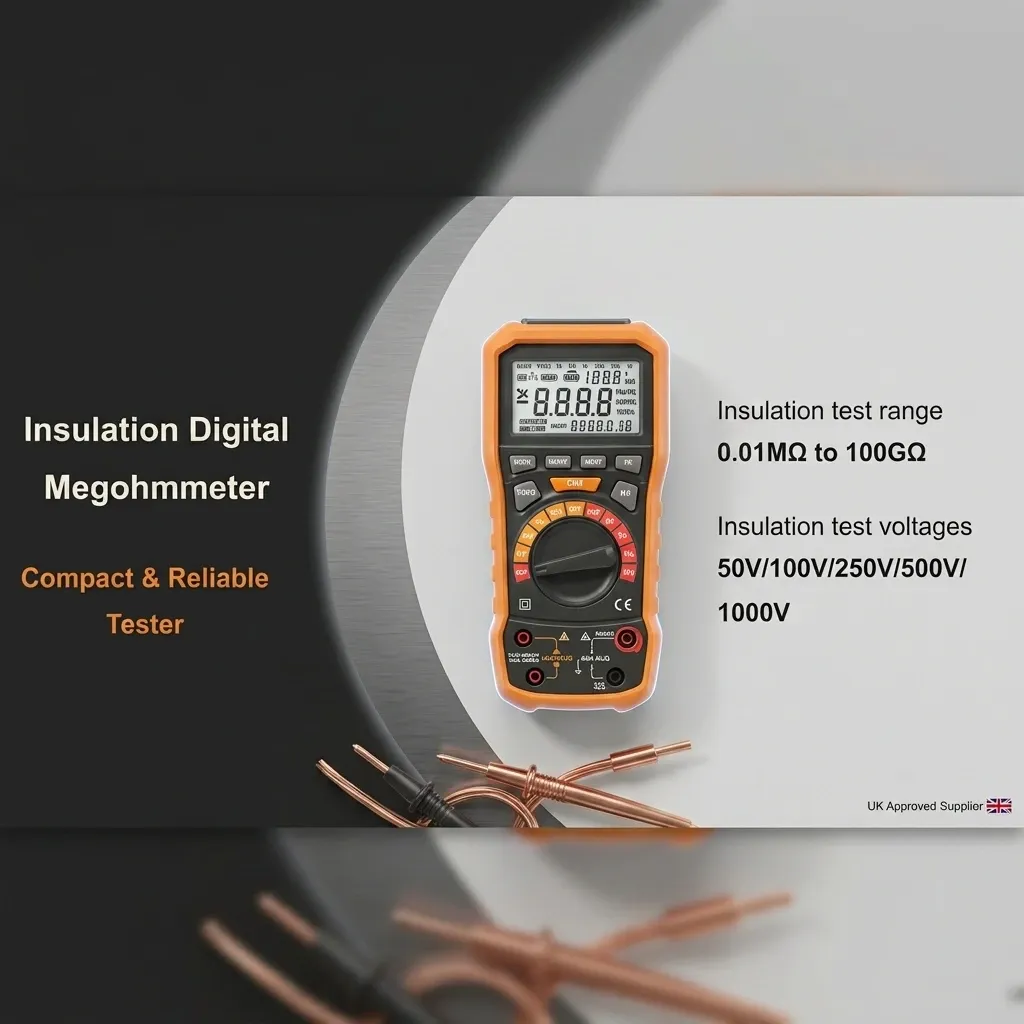
The MegaOhmTes 1000V Digital Megohmmeter Insulation Resistance Tester calculates PI and DAR on the unit, tests from 50V to 1000V across a 0.01 MΩ to 100 GΩ range, and is priced at £119.41 inc VAT (£99.51 ex VAT) with a 12-month UK warranty, which makes a repeatable PI/DAR routine affordable to roll out across a team.
Honest limits
PI and DAR are diagnostic aids, not certificates of health. They lose meaning on very high, dry insulation, where IEEE 43 notes the polarisation index becomes unreliable once the one-minute reading exceeds about 5,000 MΩ; there, rely on the absolute resistance and its trend. The test needs training to run consistently, the circuit must be isolated and discharged, and where site policy requires calibration documents you should keep the tester within its calibration interval.
Where healthy insulation reads into the gigohms and you need headroom to record a real figure, the 100G ohm megger meter guide covers high-range testing.
Frequently asked questions
What is the difference between PI and DAR?
Both compare insulation resistance over time. DAR (dielectric absorption ratio) is the 60-second reading divided by the 30-second reading, a quick check that takes a minute. PI (polarisation index) is the 10-minute reading divided by the 1-minute reading, a deeper test better suited to larger machines. A PI DAR insulation tester calculates both automatically.
What are good PI and DAR values?
For rotating machines, IEEE 43-2013 recommends a minimum PI of 2.0 for Class B, F and H insulation (1.5 for Class A); a PI of 2 to 4 is generally good and above 4 is excellent. In field practice a DAR above 1.6 is good, 1.25 to 1.6 is questionable, and below 1.25 needs investigation.
When is PI/DAR not useful?
When insulation is very high and dry. IEEE 43 notes that the polarisation index loses meaning once the one-minute reading exceeds roughly 5,000 MΩ, because the ratio becomes unstable. On very high readings, rely on the absolute resistance and the trend against previous tests instead.
Ready to try MegaOhmTes?
Shop Now — £119.41