Electrical Insulation Meter: What It Does and How to Choose One in the UK
In short
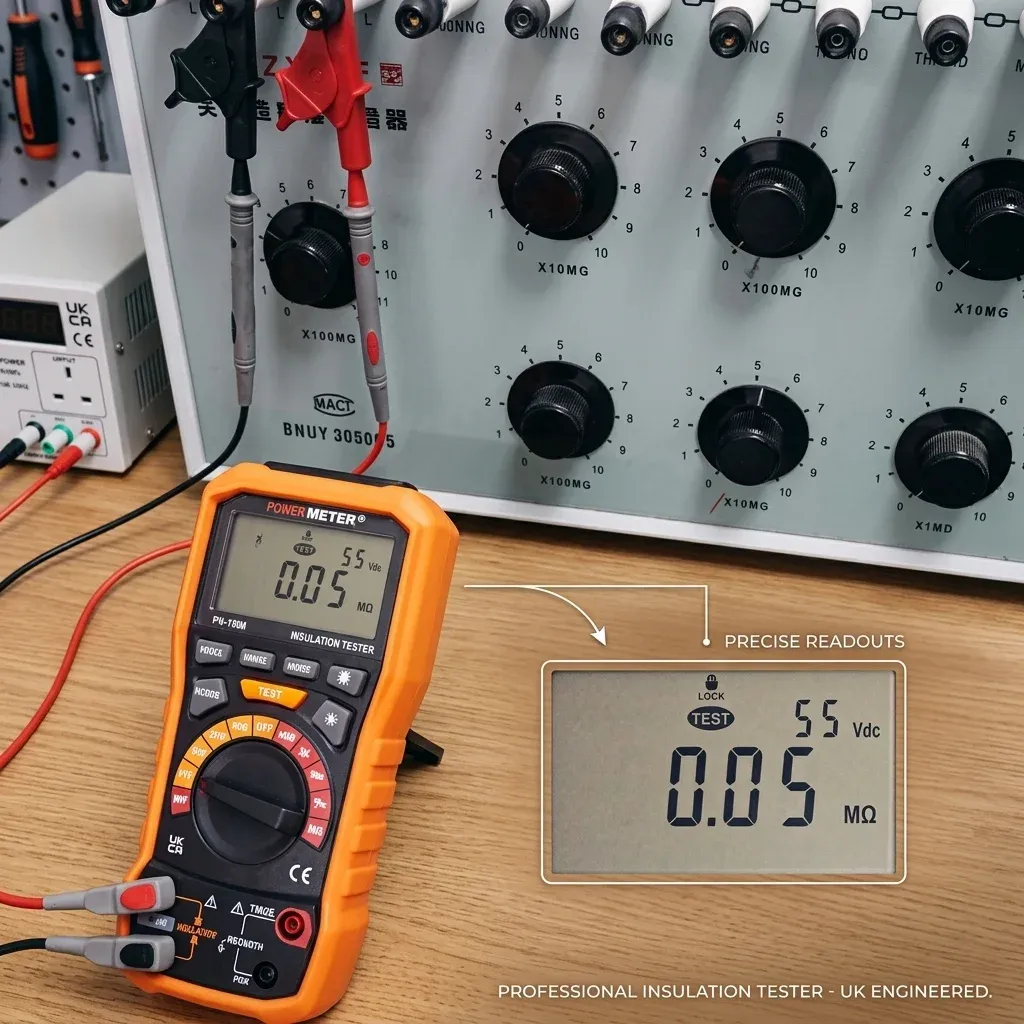
An electrical insulation meter, or megohmmeter, applies a high DC test voltage (typically 250V, 500V or 1000V) across de-energised insulation and measures the tiny leakage current, reporting the result as insulation resistance in megohms or gigohms. For a small workshop it is the one instrument that turns "the motor keeps tripping" into a defensible number. A capable 1000V unit now costs around the price of a single specialist call-out, which is why building the capability in-house often pays for itself quickly.
What an electrical insulation meter actually measures
An electrical insulation meter is not a beefed-up multimeter. A multimeter checks continuity and low resistance; an insulation meter deliberately stresses the insulation by applying a stable, high DC voltage between conductors, or between a conductor and earth, and measuring how much current leaks across. A high resistance means the insulation is holding the voltage back; a low, drifting or collapsing figure means moisture, contamination or damage is letting current through. Testing is always done on a circuit that is isolated, proven dead and discharged.
Because it works with high voltage on dead circuits, an insulation meter is a fault-finding and verification tool, not a live measurement tool. That distinction matters when you are deciding whether to invest: this is the instrument that separates a genuine winding or cable problem from a nuisance that a multimeter simply cannot see.
Which test voltage should you use?
UK practice follows BS 7671:2018+A2:2022. Table 64 sets both the test voltage and the minimum acceptable insulation resistance:
- SELV and PELV circuits (nominal voltage up to 50V): test at 250V DC, minimum 0.5 MΩ.
- Circuits up to and including 500V (standard 230V and 400V work): test at 500V DC, minimum 1.0 MΩ.
- Circuits above 500V: test at 1000V DC, minimum 1.0 MΩ.
For a new installation, Regulation 643.3 sets a two-stage approach: test the wiring at 500V DC before connecting sensitive equipment, then, after connecting it, apply a 250V DC test between live conductors and the protective conductor, still expecting at least 1 MΩ. A meter that offers the full 50V/100V/250V/500V/1000V range covers all of this without compromise, so you are never forced to over-stress a sensitive circuit.
Where you need more than a single spot value, a timed test tells you far more: see our guide to the PI DAR insulation tester method. For motors and long supply cables specifically, the motor cable megohmmeter workflow shows how to isolate the fault.
Choosing one for a small workshop without overpaying
If you run a small manufacturing or service workshop, the real decision is rarely brand-versus-brand; it is whether to keep paying for specialist call-outs or to equip a competent maintainer to do routine insulation checks in-house. A single external diagnostic visit can cost more than the tester itself, and the delay while you wait for a specialist is often the more expensive part. The aim is a strong capability-to-price ratio: professional functions without a flagship badge.
For most workshops the features that matter are selectable 50V-1000V test voltages, a wide resistance range so healthy insulation does not simply read "over range", PI/DAR for condition insight, and AC/DC voltage plus frequency on the same unit so you can prove a circuit dead before testing. Leads and probes should meet HSE GS38. Transparent pricing helps the sums: our own tester is listed at £119.41 inc VAT (£99.51 ex VAT), which makes the capability-versus-call-out comparison easy to justify to whoever holds the budget.
If your work leans towards commissioning long runs or switchgear rather than workshop plant, the higher-range angle is covered in our 100G ohm megger meter guide.
The MegaOhmTes 1000V Digital Megohmmeter Insulation Resistance Tester was built around exactly this brief: 50-1000V test voltages, a 0.01 MΩ to 100 GΩ range, PI/DAR, AC/DC voltage and frequency, CAT III 600V / CAT II 1000V safety, and a 12-month UK warranty with UK support, at £119.41.
Honest limits
An insulation meter tells you about insulation condition; it does not replace safe working. You still need safe isolation, the right PPE and, on anything beyond your competence, a qualified person. It will not diagnose mechanical faults, and a single reading in isolation can mislead, so record results and watch the trend. Where a job demands calibration traceability or data logging for certification, choose and budget for a tester that meets that requirement rather than retrofitting it later.
Frequently asked questions
Is an electrical insulation meter the same as a multimeter?
No. A multimeter measures continuity, voltage and low resistance on live or dead circuits, but it cannot apply the high DC test voltage needed to stress insulation. An electrical insulation meter applies 250V, 500V or 1000V DC across de-energised insulation and reads the leakage as resistance in megohms or gigohms, which is what reveals a breakdown before it trips.
What is a good insulation resistance reading in the UK?
Under BS 7671:2018+A2:2022 Table 64 the minimum is 1.0 MΩ for circuits up to 500V (tested at 500V DC) and 0.5 MΩ for SELV and PELV (tested at 250V DC). Those are pass/fail floors, not targets: sound new wiring usually reads hundreds of megohms or more, so treat anything close to the minimum, or falling over time, as a reason to investigate.
Can I use an electrical insulation meter on a live circuit?
No. Insulation testing is always done on a de-energised, isolated and discharged circuit. Prove the circuit dead with a voltage indicator to HSE GS38, follow safe isolation under the Electricity at Work Regulations 1989, and only then apply the test voltage. Most testers include an AC/DC voltage function so you can confirm the circuit is dead first.
Do I need a calibration certificate for an insulation meter?
For your own fault-finding, no. But if you issue certification or work to a client's quality system, many sites ask for evidence of calibration traceability. Decide up front: for in-house diagnostics a capable tester is enough; where paperwork is contractual, budget for periodic calibration.
Ready to try MegaOhmTes?
Shop Now — £119.41