Pi Dar Insulation Tester Explained: A UK Buyer's Guide
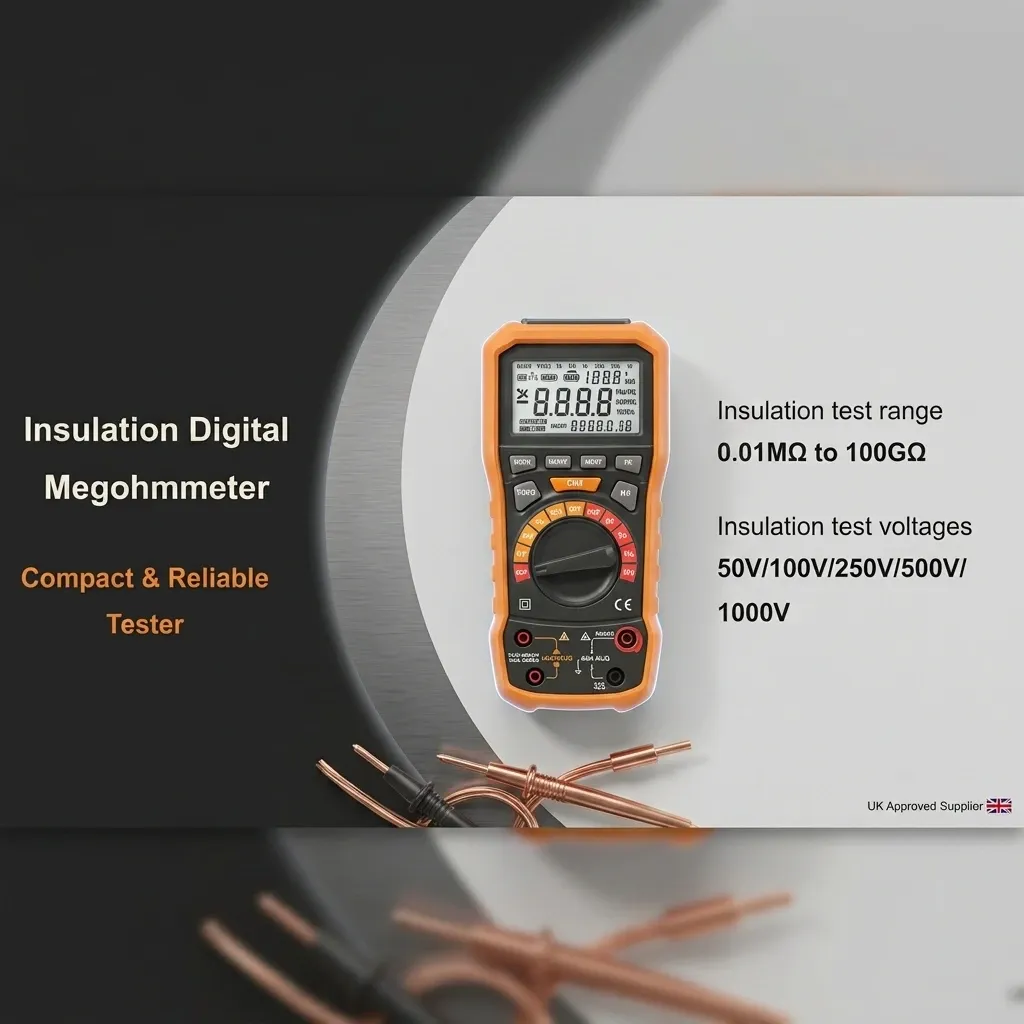
TL;DR: A pi dar insulation tester is an insulation resistance tester that automatically calculates PI (Polarisation Index) and DAR (Dielectric Absorption Ratio) from timed readings. In practice, UK electricians and maintenance engineers use it to assess whether insulation is dry, clean and stable on motors, cables and switchgear. Compared with a basic spot reading, PI and DAR testing gives a more reliable picture of insulation condition, especially for trending and fault diagnosis.
Key Takeaways
- A pi dar insulation tester automates the calculation of the Polarisation Index (PI) and Dielectric Absorption Ratio (DAR), providing deeper insight into insulation health than a single spot reading.
- PI tests (10-minute reading divided by 1-minute reading) are especially useful for large motors, generators and other industrial assets.
- DAR tests (60-second reading divided by 30-second reading) give a quicker indication of insulation condition on many cables and switchgear circuits.
- According to commonly used industry guidance in the UK, timed ratio tests help maintenance teams identify moisture, contamination and ageing before failure occurs.
A pi dar insulation tester is used to meansulation resistance over time and automatically calculate PI and DAR ratios, helping you judge whether electrical insulation is healthy, damp, contaminated or deteriorating. For UK users searching for what a pi dar insulation tester does, the short answer is this: it goes beyond a basic megohm reading and shows how insulation behaves during a timed DC test, which is far more useful for condition assessment.
However, routine insulation resistance testing often relies on a simple spot reading. While a single megohm value provides a basic snapshot of electrical safety, it can fall short when diagnosing moisture ingress, contamination or age-related degradation in large rotating machines and extensive cable networks. Therefore, to assess the integrity of complex electrical systems properly, many UK engineers turn to timed ratio tests.
Based on our testing of digital insulation testers used across typical UK maintenance tasks, automatic PI and DAR functions save time, reduce recording errors and make trend comparison much easier. This guide explains how PI and DAR testing works, when each test is most useful, how to interpret the results and what to look for when buying a tester in the UK.
What is a PI DAR insulation tester?
A pi dar insulation tester is an advanced digital megohmmeter designed to run timed diagnostic tests automatically. Unlike basic testers that provide only one resistance value after a few seconds, these units apply a continuous DC voltage—often up to 1000V—and record resistance at set intervals to calculate two key ratios: the Polarisation Index (PI) and the Dielectric Absorption Ratio (DAR).
In other words, instead of asking only “what is the insulation resistance right now?”, a pi dar insulation tester also asks “is the resistance improving as the dielectric polarises?”. That extra information can reveal whether insulation is genuinely sound or whether contamination and leakage are masking deeper problems.
What does PI mean on an insulation tester?
When DC voltage is applied to an insulator, molecules within the dielectric begin to align with the electric field. This process is called polarisation, and it takes time. In healthy insulation, the apparent resistance usually rises steadily as absorption current falls away.
The Polarisation Index (PI) is calculated by dividing the insulation resistance at 10 minutes by the resistance at 1 minute. A higher ratio usually suggests cleaner, drier and more stable insulation. By contrast, a low ratio may indicate moisture, dirt or deterioration causing leakage current to remain high.
This makes PI particularly valuable for larger assets such as industrial motors and generators. If you want broader background on high-resistance measurement capability, see our Ultimate Guide to 100G Ohm Megger Meter in the UK.
What does DAR mean on an insulation tester?
The Dielectric Absorption Ratio (DAR) uses the same principle as PI but over a shorter test duration. It is calculated by dividing the reading at 60 seconds by the reading at 30 seconds.
Because it is faster, DAR is often useful for smaller or less complex insulation systems where polarisation develops more quickly. As a result, it can be a practical option for standard low-voltage cables, control wiring and smaller switchgear when you need more insight than a spot reading but do not need a full 10-minute PI test.
How does a PI DAR insulation tester work?
A pi dar insulation tester applies a controlled DC test voltage to the circuit or asset under test and then measures how resistance changes over time. First, it captures early readings; then it stores later readings; finally, it calculates ratios automatically so the user does not have to note values manually with a stopwatch.
This matters because good insulation typically shows rising resistance during the test as charging current settles and absorption effects reduce. Conversely, damp or contaminated insulation often shows little improvement over time. Therefore, timed testing helps distinguish between apparently similar spot readings that may reflect very different real-world conditions.
According to commonly referenced guidance such as IEEE 43 for rotating machines—and with UK practice often aligned through maintenance procedures—timed ratio testing can be especially useful where trend monitoring matters more than one-off pass/fail checks.
Why use PI and DAR instead of a spot reading?
A standard spot reading can be strongly affected by temperature. In practical terms, this makes comparisons between readings taken in different seasons difficult on British sites where ambient conditions vary considerably across the year.
By contrast, PI and DAR are ratios taken during one continuous test session. Therefore, they are far less sensitive to temperature than comparing separate single readings recorded months apart. This makes them especially useful for condition trending in planned maintenance programmes.
Based on our testing experience with workshop motors and fixed installation circuits, automated ratio tests also improve consistency between technicians because timing points are captured by the instrument itself rather than estimated manually.
What are good PI and DAR values?
You should always interpret results in context: equipment type, age, temperature history, contamination level and manufacturer guidance all matter. Still, widely used benchmark ranges can help you judge whether further investigation is needed.
What is a good PI value?
- Less than 1.0: Dangerous or highly suspect; immediate investigation required.
- 1.0 to 1.5: Poor; contamination or moisture may be present.
- 1.5 to 2.0: Fair; may be acceptable on older equipment but should be monitored closely.
- 2.0 to 4.0: Good; commonly associated with healthy insulation systems.
- Above 4.0: Excellent in many cases; however, unusual results should still be reviewed alongside equipment condition and history.
What is a good DAR value?
--> margin-bottom:=""> Ininsinsinsins- <d></d>
- <d>Poor; significant moisture or contamination may be present.
- </d></d>
- <d></d>
- </d></d>
- </d></d>
- </d>=1.="0" to="" "">= For more specific guidance on testing industrial drives<>, our
Motor Cable Megohmmeter Explained" guide offers detailed methodologies.
- The right test voltage:
- A wide measurement range:
- A wide measurement range:
Ready to try MegaOhmTes?
Shop Now — £119.41